How Rotary Clubs on Three Continents, Together with Madiro and Ubuntu Village of Life, Brought a Life-Saving Ambulance to Rural Burundi
By James Fraser* and Chris Snyder
There Is More Good News in the World Than Bad
On New Year’s Day a small ceremony took place outside Ubuntu Village of Life’s rural hospital in Mugamba, a community in Burundi’s mountainous interior. People arrived on foot, by bicycle, and from neighboring hills. There were no banners, no official speeches, and no visiting dignitaries. The occasion was straightforward and deeply practical. The Rotary Club of Bujumbura was formally handing over a new ambulance to Ubuntu Village of Life (UVL). Click the link to watch the video:
https://drive.google.com/file/d/1ygXNuN8a_56agKDLOUKQFpvMNQkZvgtW/view?usp=sharing
For years, the hospital had relied on an aging vehicle that could transport patients from Mugamba to the referral hospital when conditions allowed. But it could not do the more dangerous, more urgent work — traveling into the surrounding rural mountains to reach patients in crisis: women experiencing complications during labour, children with life-threatening pneumonia, or severe cases of malaria stranded far from paved roads.
That limitation had consequences. This ambulance will change that.
Why an Ambulance Matters Here
Burundi is frequently cited among the poorest countries in the world. It is overwhelmingly rural and agricultural, and access to healthcare is deeply uneven. For people living far from urban centers, distance itself becomes a medical risk. According to the Canadian Institute of Health Information, Canada has 1 doctor for every 675 people. Burundi, according to the WHO, has 1 doctor for every 60000 people. In this context, delay is not neutral. It is often fatal.
Malaria remains one of the country’s most serious public health threats, particularly among children under five. Pneumonia and other respiratory infections are also major causes of illness and death. Oxygen is scarce, and emergency transport is often nonexistent — especially in rural and mountainous regions like Mugamba.
At Ubuntu Village of Life, these realities are not abstract. Clinicians regularly treat severe malaria, children struggling to breathe with pneumonia, and women experiencing complicated pregnancies. When patients deteriorate the ability to reach them, not just transport them onward, is critical.
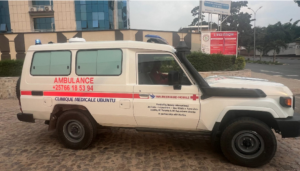
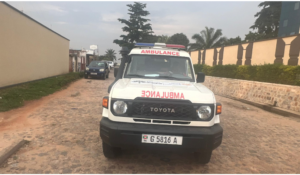 The previous vehicle could move patients once they arrived at the hospital. The new ambulance can go out into the mountains, reach patients where they are, stabilize them, and bring them safely to care. In a region defined by steep terrain and limited infrastructure that difference saves lives. The ambulance did not arrive in a vacuum. It arrived at a hospital that had already demonstrated commitment, competence, and the trust of the community it serves.
Ubuntu Village of Life was founded by Dr. Alexis Nizigiyimana **under extremely modest conditions. During the height of the COVID-19 pandemic, it operated out of borrowed spaces — including a rented bar — with a small house across the road serving as a makeshift maternity ward. Even then, patients came. Care was provided. The need was unmistakable.
 With sustained support from Madiro, that early effort was transformed. What began as improvised care in borrowed rooms, became a functioning rural hospital with inpatient capacity, emergency services, maternity wards, laboratory and pharmacy services, and satellite outreach.
Step by step, UVL built the clinical, operational, and administrative foundations needed to serve a remote, mountainous population with dignity and reliability.
The arrival of the ambulance now allows that care to extend far beyond the hospital walls. It enables clinicians to reach deeper into rural communities, into the surrounding hills where distance, terrain, and poverty compound vulnerability. Women in complicated labour, children with severe infections, and patients too weak to travel can now be reached earlier — and brought to care safely.
This is how impact scales in places like Mugamba: not by adding services in one location alone, but by projecting care outward to reach those who would otherwise be left behind.
How This Ambulance Came to Be
What makes this story remarkable is not only the arrival of the ambulance in Mugamba, but the way it came to be there.
The vehicle was funded through a partnership of 24 Rotary clubs spanning three continents:
20 clubs across Canada
- One club in India
- One club in the Philippines
- One club in Burundi
The Rotary International Foundation
Most of the Rotarians involved had never been to Burundi, and many had no prior connection to the country at all. What linked them was Rotary, itself — a shared commitment to, “Service Above Self,” and trust in fellow Rotarians and partners working on the ground. This project was driven not by proximity, but by shared values. That trust mattered.
Many of the participating clubs were already familiar with Madiro’s leadership, who have collaborated with Rotary clubs on international projects since 1994. That long-standing relationship helped establish confidence early — not only in the viability of the project, but in the partners responsible for seeing it through. In complex, multi-club initiatives like this, trust reduces friction, shortens decision cycles, and helps momentum build rather than stall.
The financial scale of the project was modest by global standards. What made it demanding was the process.
Each of the 24 clubs had to approve the project independently. Funding had to move through Rotary International’s global grant system, designed to ensure transparency, accountability, and responsible stewardship. A local Rotary club had to be involved. Matching funds had to be secured through the Rotary Foundation. Documentation had to be precise. Timelines had to align.
For a project like this to succeed, someone needed to take responsibility for holding it together. That role was taken on by the Rotary Club of Toronto, with the initiative led by Chris Snyder and Maureen Bird. Together, they worked closely with fellow Rotarians to coordinate approvals, engage partner clubs, and navigate the requirements of Rotary’s grant process — keeping the project moving when complexity and distance could easily have slowed it down. This kind of collaboration does not happen quickly. It happens because people are willing to stay with the work.
Doing the Work That Gets Things Finished
In practice, that work often took the form of emails, follow-ups, documents, and deadlines — the unglamorous tasks that determine whether a complex project actually crosses the finish line.
Much of that effort fell to Maureen Bird. She tracked approvals, followed up with participating clubs, and ensured that Rotary’s requirements were met in full. Her contribution was quiet and largely invisible, but it was essential.
At the time the Rotary Club of Toronto formally committed to the ambulance project, Maureen was battling bladder cancer and shortly afterward was in a severe car accident with a long recovery period. She continued anyway, much of which was from her bed.
Between medical appointments and chemotherapy treatments, Maureen stayed engaged — responding to questions, finalizing documentation, and stepping in when delays threatened to stall progress. She did this not to claim credit, but because she believed the work mattered, and that it mattered to finish it properly. She remained involved until only days before she died.
By that point the funding had been secured. The money was in the bank in Burundi. Agreements were signed. Shipping arrangements were complete. Her work was one part of a collective effort — but it was a decisive one.
When the ambulance was formally handed over in Mugamba, the community asked to name it in Maureen Bird’s honour. The ambulance is now known locally as the MAUREEN BIRD MOBILE .
A Journey Across the World
The ambulance itself traveled a long and complex route before reaching Mugamba — from Japan to Dubai, then to Tanzania, and finally overland into Burundi. From the initial idea to the moment the ambulance was handed over, the process took approximately 18 months.
That timeline reflects a reality often overlooked in international cooperation: projects that are done properly — ethically, transparently, and in genuine partnership with local institutions — take time. They require patience, trust, and a willingness to work through complexity rather than around it.
What This Moment Represents
This ambulance will save lives. It will reduce delays in emergency obstetric and pediatric care, ensuring that patients can be reached and transported to care, before conditions become irreversible. But its significance extends beyond any single vehicle.
 Rotary clubs on three continents, working together through a shared commitment to service, found a way to act collectively. Madiro helped bridge global partners and local reality. Ubuntu Village of Life provided the grounding and capacity to translate that effort into care that reaches the most vulnerable.
For families in the hills around Mugamba, this ambulance means something very simple: when a child cannot breathe, when labour turns dangerous, when malaria becomes severe, help can arrive in time.
That is what this project was for.
Till next time,
Chris Snyder, climate optimist
Email: snyderchris74@gmail.com
Stories of Good News and Hope: https://chrissnyder.makeanimpact.ca
* James Fraser is the CEO of Madiro, who focuses on health care in Africa. He has had senior roles in Doctors without Borders, Chip Care and was President of Dignitas International. In 2007 he was selected as one of Canada’s top 40 under 40.
** In appreciation Dr Nizigiyimana wrote, “This moment belongs to you. Seeing the ambulance arrive at UVL Hospital moved me deeply – I truly felt tears in my eyes. What the ambulance represents for our community, for mothers, children, and families in our village is beyond words.
Your dedication, persistence, and heart in mobilizing the Rotary Clubs globally to make this life-saving gift possible are extraordinary. On behalf of myself, the entire UVL team, and my family, please receive our deepest love and gratitude.
Because of you lives will be saved, emergencies will be answered, and hope will reach people when they need it the most.
Thank you for believing in UVL, for standing with our community, and for turning compassion into action. May God bless you and your family abundantly for all you have done.”
– Dr Alexis Nizigliyimana
You May Also Like
Cambodia!
Getting Along and the Golden Rule
