Caregivers: Our Unsung Heros. What Would We Do Without Them?
THERE IS MORE GOOD NEWS IN THE WORLD THAN BAD
DAVID

As David opened his eyes, he saw in front of him a strange mix of people standing at the foot of his bed. He noticed others were scurrying around, pushing people on beds like his. Those in the beds all had tubes hanging from their arms and a bottle on a post beside them. He had no idea where he was. AS his sedative began to wear off, he realized he was in the recovery room of a hospital, having just had a bypass operation, a valve replacement, and in a few days would get a pacemaker.
These men and women, who were all dressed in baggy green clothes, were all shapes, sizes, colours, ages, and ethnic backgrounds. David had never seen or met any of these people, nor had they met him. He slowly started to realize these people, who were all strangers, had all arrived in Canada from other countries and were all working diligently together to keep David and the others alive. THEY WERE THE CAREGIVERS. Upon realizing this amazing happening, David was overcome with emotion, and tears of gratitude started to roll down his cheek.
Over the next 5 days, David shared personal stories with not just those in the recovery room, but also others assigned to the ICU and the regular ward. He learned about their families, their country of origin, why they came to Canada, their hopes and dreams, why they became caregivers, and the good and difficult parts of the job. By the time he went home, he felt he was a member of a community.
Some 5 years later, now fully recovered, David is still as thankful for their care as he was when he came out from under his anesthetic. Since then, he has met and been reliant on many other caregivers, doctors, nurses, massage therapists, social workers, physios and more. After he left the hospital, his wife became his primary caregiver, as he still needed help to take his medication, prepare his food, help him bathe and get dressed: in general, to help him get back to his old self.
SANDRA
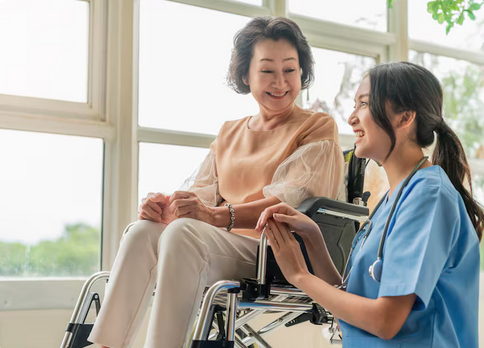
Several years ago, Sandra had been diagnosed with Parkinson’s. Her disease progressed rapidly, and after 3 years, she was virtually bedridden. Since her husband was working full-time, her family hired two trained caregivers from the Philippines to help. Since she could not exercise, Sandra started to gain a lot of weight. Even though these women were small, they were able to coax and lift Sandra out of bed, feed her, bathe her, and read to her. Sometimes they sang together. They became her close companions.
When around, Sandra’s husband and children helped move her to her activities, including her car rides. In addition to special attachments on the car, it took 2 people to get her into and out of the car. Amazingly, these caregivers seemed to thrive on helping and making Sandra’s life more comfortable.
WHAT IS A CAREGIVER ?
Simply stated, a caregiver is a person who provides care to people who need help taking care of themselves. Some are professionally trained medical people, some are trained caregivers: people who work in assisted care facilities or who come into one’s home to help with day-to-day activities. Many are family and friends. In fact, Stats Canada tells us an estimated 1 in 4 family members become caregivers at some point in time. Data also indicates that approximately two-thirds of the people who provide more than 20 hours per week of care are family members. According to The Canadian Centre For Caregiver Excellence, 35% of the labour force are juggling a job while caring for someone on the side. More than 50% of caregivers are women, a responsibility thrust on them largely because of inherited gender roles.
WHAT DO CARE GIVERS DO?
The list of responsibilities can be endless, but it depends on the needs of the individual being cared for. Some caregivers tell us it can be like taking on a whole extra life.
If in an institution or in the person’s home, responsibilities could range from: feeding the individual, coordinating their activities, bathing them, getting them dressed, doing their laundry, giving them their meds, and being their companion. For this, the average pay for a trained caregiver in Canada, according to a number of sources, is $20-$25 per hour. Family members are generally paid with love and affection.
If a caregiver comes to your home, the duties could be the same as in an institution, but could also include: taking them to places, purchasing food, arranging meals, or paying their bills. Some come for a few hours to spell off a spouse so they can go out, and some live in the home.
There are a number of organizations that provide these services. Determining the services you need is often difficult. The Baycrest Centre in Toronto provides an excellent online service called the Canadian Caregiver Assessment and Resources Tool Kit, which can help you determine what you need. Often, however, the care falls to family members and friends.
WHAT DOES IT TAKE TO BE A CAREGIVER?
In brief, if you have ever watched a good caregiver in action, it is easy to conclude that good caregivers can be halfway to being a saint. The long list of what is needed to be a good caregiver can include: 1) patience, 2) compassion, 3) humour, 4) being present in the situation, 5) detail-oriented, 6) physical strength, 7) able to accept help, 8) cooperative, 9) caring, 10) resilient and 11) cheerful.

This list is far from complete. Being a caregiver is hard work, stressful, emotional, and often leads to burnout. Burnout was a common cry during COVID; however, it is far from limited to then.
Caregiving can lead to exhaustion, social withdrawal, panic attacks, lack of appreciation by the person and family being looked after, loss of interest in things, and depression. Often, people looking after their parents also look after their children and hold down a full or part-time job. Sometimes, as much as the person loves who they are caring for, it is just too much to take, and people need to stop or take a leave of absence from their job. Often, it requires the heart-wrenching decision of putting the person in a home, bringing with it concerns about the cost.
TO THE RESCUE
Because of demographics, the number of people needing help is increasing. Adding to this, people are living longer in part because of the impact of drugs, and family sizes are getting smaller, making fewer family members available to help.
Some employers are recognizing this. Often, the people who look after their parents are amongst the best employees. Companies wishing to retain employees are starting to provide their employees with flexible hours or a leave of absence.
SUN LIFE, for example, realized this need during COVID, so the company decided to allow people to take 5 emergency days off, taking them in hourly increments or in whole days. Sun Life and other employers now allow employees to take this time in whatever way is most needed.
The government recognizes the increasing need and difficulties associated with family members needing extra care, particularly in their home. There is a large range of Government benefits, including tax concessions and financial incentives. For details, go online to the government legislation for Caregivers link. There are also charities that recognize and support the needs of caregivers.
YOUNG CHILDREN
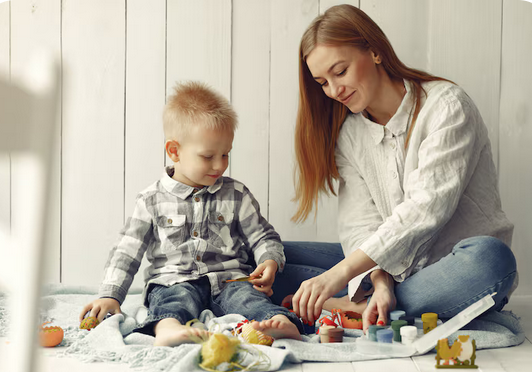
We have all heard the saying, “It takes a whole village to raise a child.” In many families with both spouses working, or in an emergency, it is not unusual for grandparents to come to the rescue, as is sharing from time to time with friends.
Baby sitters are a necessity in many families, and daycare centres are learning places for many young people, and allow for both parents to work. Children’s lessons and sports programmes, in some cases, are de facto caregiving organizations.
Because of shortages, nannies often come from other countries to care for children (au pairs age 18-28), often giving them a leg up on becoming a permanent resident. Nannies are a staple in many families, often becoming an integral part of the family. Think of the movie, “The Sound of Music.” Not surprisingly, the Royal Family had nannies. Mabel Anderson was, for many years, the nanny for the King and his siblings. She remained a close friend of the family. In fact, the King recently paid a visit to her home on her 100th birthday.
INDISPENSABLE
Most of us will need a caregiver at some time, and when we do, they are indispensable. Looking after others can also be an indispensable and vital part of a caregiver’s life.
In closing, here is one family’s story*
THE HILBORN FAMILY
My late wife, Nancy Hilborn, was seized by early Alzheimer’s in her late-sixties. As is often the case, the early signs were subtle and easily ignored as some senior forgetfulness. But once she started turning up for unbooked appointments and wandering around town too lightly clothed in the dead of winter, we knew. The steady progression of her voyage then became unstoppable; First there were housekeepers to back up her daily routines; then she moved to a high-end seniors’ home, and finally to full continuing care as her faculties were gradually undermined, and mentally she surely, but slowly, left our world behind.
Nancy took her time about the insidious process of departure, stretching it out over several decades and existing in her last five or six years in a state of passive non-communication, a state often called vegetative. But because we all loved this great woman so much, so deeply, and the squadron of amazing women from Silverthorn Care Centre on Mississauga Rd, most of whom hailed from the Caribbean, South America, and around the world, could not think of her that way.
The years passed slowly for her, but as we visited, our love for this woman somehow permeated the hearts of the ladies and the few guys on duty at the Silverthorn, and the extended laughter and one-way conversations with her took on the nature of relaxed family chatter. At times, it seemed as if this woman, who had left home mentally, had decided to settle in permanently otherwise. There were ups and downs, and adventures – some quite hilarious – and we got to know the ladies and vice-versa.
When the time came to go, my weeping daughter told Nancy, “It’s o.k. to go Mom. We’re all here with you. You can go now,” and she left us. It seemed then that in minutes (I guess a little longer), the room was full of those beautiful women who had tended to every need for all of those years, crying, hugging us, and sharing our sadness at the need to finally say goodbye to this determined woman who had hung on to life so tightly. Their sincere distress reminded me that we are all, as John Donne put it, “a piece of the continent, a part of the main,” and that the bell is tolling for all of us.
* Jim Hilborn, is the author of this story and editor and publisher of Civil Sector Press, the publisher of several of my books, including 52+ Good News Stories
Till next time,
Chris Snyder, climate optimist
Email: snyderchris74@gmail.com
Stories of Good News and Hope: https://chrissnyder.makeanimpact.ca
You May Also Like

Saying Positive and Supportive Things to Others

Getting Along and the Golden Rule